The new European Budget: why it matters for the Northern Netherlands
As the Northern Netherlands, we have a long track record of turning European investment into real results for our people and our economy. The EU's next Multiannual Financial Framework (MFF), covering 2028 to 2034, is now being negotiated. What is decided in Brussels will determine what is possible in our region for years to come.
The strength of Cohesion Policy lies in its partnership principle at regional level. In our region, public authorities, businesses, and knowledge institutions work closely together. They connect the local economy, building on the strength of the region, aiming to further develop innovation ecosystems and strengthen our future regional capacity and competitiveness. Additionally, European Structural Funds are indispensable for the implementation of our Regional Innovation Strategy.
Our position
Together with our partners from across Europe, we are calling for our European and national partners for a new budget framework that reflects the diversity of regional realities, leverages local knowledge, and ensures that every euro spent delivers impact where it matters most. Specifically, we stand for:
- Strong Cohesion Policy: Design and implement the European regional funds at the level of the country's macro-regions (regional scale). We need an ambitious, adequately funded cohesion policy that reduces disparities and strengthens European competitiveness, ensure a fair allocation of resources in line with their intended purpose, with effectiveness as the guiding principle; for example, reducing regional disparities through Cohesion Policy.
- Ensure access for regional and local authorities to European funding, including Cohesion Policy funds, inthe new MFF, while also ensuring good access for SMEs through the proposed Competitiveness Fund. Additionally, preserve the level of funding allocated to the region (including the European Structural and Investment Funds) within the MFF (the overall size of the funding envelope). We ask for integrated programming and implementation of EU funds with full regional participation.
- Real regional ownership: Maintain the European budget for regional policy as an essential instrument for regional socio-economic development. When funding under the National Reform and Partnership Plans (NRPPs) is no longer earmarked for regions, but instead channeled through Member States, there is a growing risk that European support for regional economies and regional programs will diminish. Regions must be able to implement their own regional sections, as weare best placed to identify local and regional challenges and opportunities, enabling us to determine how funding can be deployed most effectively. The close proximity between regional authorities, businesses, and civil society organizations allows for an easy stakeholder engagement and allocation of tailored funding In addition, administrative burdens must be reduced for applicants and recipients of funding, including SMEs , as they play an important role in strengthening competitiveness and driving the clean and digital transition.
- Stronger links between different funding instruments and strategies so that reinforcement of the funds is more effective. Allign the European Development Fund (ERF), the European Social Fund Plus (ESF +), the Interregional Investments Instrument (I3 Instrument), Research and Innovation Strategies for Smart Specialisation (RIS3). This approach promotes clean, economic, and social transitions in regions, enabling more effective support for innovation, sustainability and regional development.
The case for regional cohesion policy
As the geopolitical landscape and the COVID-19 pandemic have prompted the EU to make its budget more flexible and strategically focused, it is more important than ever to safeguard the principles that underpin a strong, competitive, and resilient Europe. Strong regions are essential to achieving this. Centralization proposals of regional funds would undermine exactly these types of regional projects that are important for local social and economic development in times of transition. Negative impact on regional and local EU funding must be avoided, due to insufficient or lagging reforms at national level. Only through genuine regional design, management, and implementation do European investments reach the people and places they are meant to serve and have real lasting social and economic impact.
Circulair
Expertise circular
“Every territory has a unique set of circumstances and knows best how to address them. So, we need to listen to our regions – instead of having a single recipe for all."
– President von der Leyen at the Annual EU Budget Conference in 2025
Regions and cities are not only key partners in delivering EU priorities but are also best placed to identify local challenges and opportunities, and they ensure that European investments are targeted and effective. They play the most vital role in delivering the regional thematic programmes as bussinesses, knowledge institutions and governments are connected. This aligns EU funds with EU's strategic goals, enhancing Europe's competitiveness and autonomy.
This is why Strong Northern Netherlands is engaged with our stakeholders at National and European level, teaming up with other European cities and regions. As the role of cities and regions risks becoming marginalized, Northern Netherlands sends a clear message: regions should remain at the heart of European Cohesion Policy.
Our track record with delivering tangible regional development
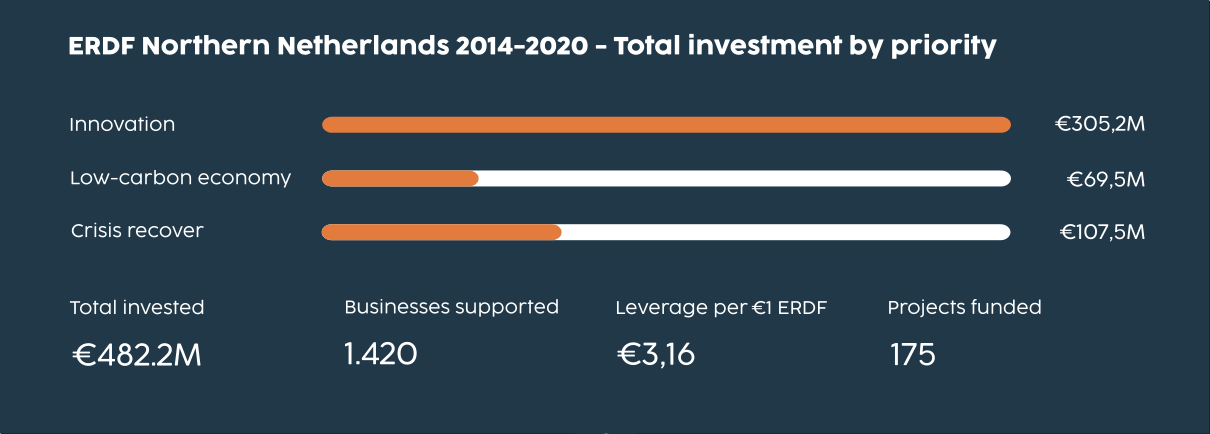
Our track record speaks for itself, and we stand ready to illustrate. In the 2014–2020 period, 175 ERDF-supported projects delivered €482.2 million in total investment across the Northern Netherlands, supporting 1,420 businesses and mobilizing €3.16 for every single euro of European funding . We did not achieve this alone, it was the result of sustained collaboration between our provinces, our cities, our businesses and our knowledge institutions. That model is precisely the model Europe should be strengthening, not diluting.
In the current 2021–2027 period, Northern Netherlands received €330 million from the Just Transition Fund (JTF) to support the energy transition, and approximately €130 million from ERDF, topped up with co-financing. Our region faces significant challenges from the energy transition and subsequent demographic change. Therefore we are using the JTF funds to strengthen our knowledge economy and address the socio- economic consequences of halting the gas extraction. This model of European funding, earmarked by the European Commission specifically for the regional level, is a structural necessity for sustainable transition and a strong regional economic profile. a We are on our way to use the money well, managed at our regional level.
ERDF
What is at stake for the Northern Netherlands?
Within the the proposed new MFF architecture, built around National and Regional Partnership Plans (NRPPs) and a new Competitiveness Fund we actually want to remain able to deliver the tailor-made, place-based programmes our regional and local economies need. Therefore, we continuously take action alongside our numerous European partner regions. Cohesion Policy can only be effective if regions and local authorities play a meaningful role in both its design and implementation. The new Multiannual Financial Framework should therefore strengthen the principles of partnership, subsidiarity, and multilevel governance, ensuring the direct and continuous involvement of regions alongside the European Commission. This will help ensure that EU funding is targeted effectively, place based, and delivers the greatest impact on regional development and Europe's long-term competitiveness.
atstake
Background: What is the MFF?
The Multiannual Financial Framework (MFF) is the European Union’s long-term budget set for a seven-year period and agreed between Member States and EU institutions. It defines the EU’s spending priorities and the overall allocation of financial resources across policy areas. From this framework are financed a wide range of EU programes, including the Structural funds. These are central to Cohesion Policy and include the European Regional Development Fund (ERDF), the European Social Fund+ (ESF+) and the Just Transition Fund (JTF), all of which support regional development and aim to reduce economic, social and territorial disparities across Europe. In addition, the MFF also funds other major EU programes such as Horizon Europe for research and innovation and the Connecting Europe Facility (CEF) for transport, energy and digital infrastructure, and these are also of major regional importance.
A strong regional Cohesion policy is a necessity to reach regional prosperity. European Cohesion policy is the largest investment program in the European Union. Our goal is to reduce economic, social, and territorial disparities between regions, and to strengthen the competitiveness of Europe as a whole. For the Dutch provinces, Structural Funds represent the only structural source of investment capital available for regional economic development.